


Sharpening Precision: Dot Torture Drill with the Taurus Executive Grade Revolver
Firearm ownership entails more than the right to carry and shoot. It carries the responsibility to train with purpose. Whether for personal defense, competition or the satisfaction of honing a skill, the range serves as a classroom where discipline and repetition translate into improved performance. Among the most effective tools for building that discipline is the Dot Torture Drill: a deceptively simple, yet demanding, accuracy exercise that reduces shooting to its fundamentals.
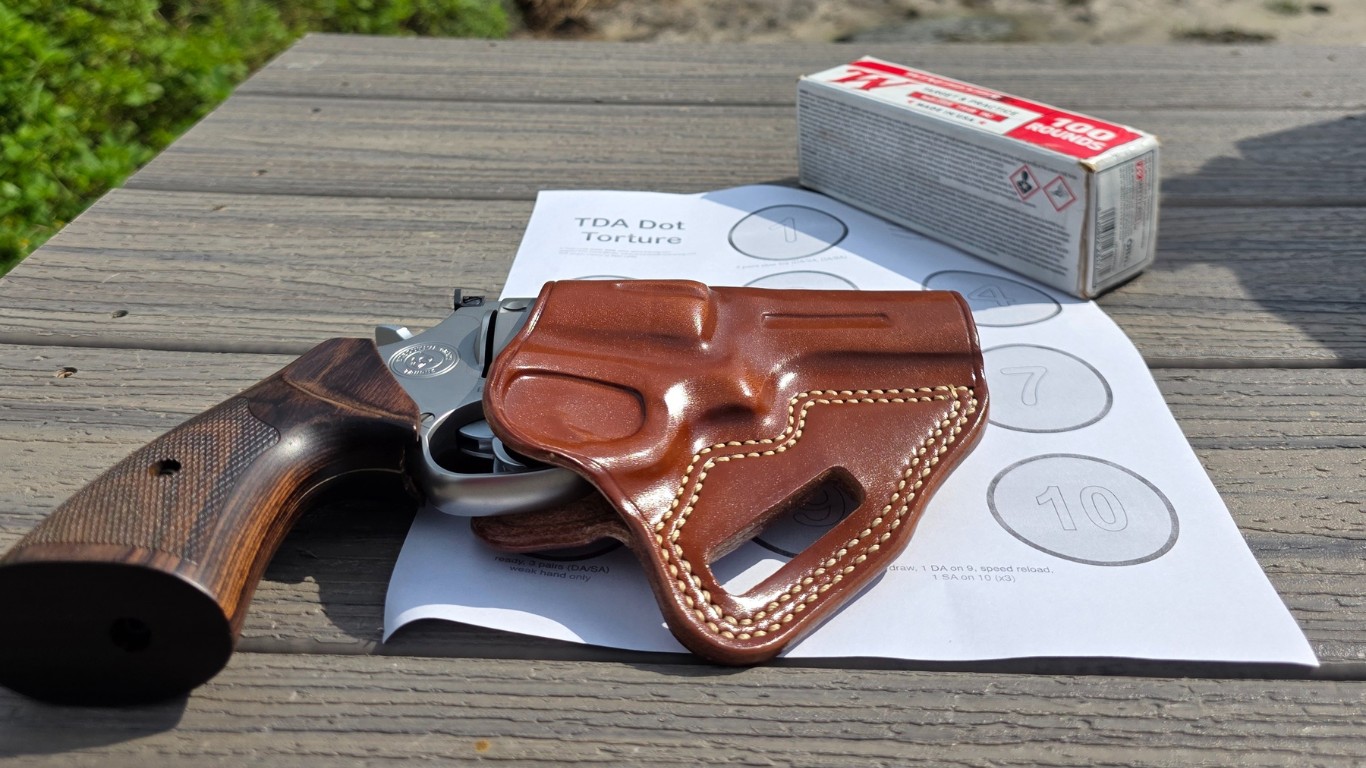
As I wrote previously, I am newer to the world of revolvers. I’ve dipped my toe into the water and am happy to report a growing affinity for the firearm that showcases the intersection where tradition meets innovation. Recently, I had the opportunity to run the Dot Torture Drill with the Taurus 692 Executive Grade revolver in 9mm. What I discovered was more than a test of accuracy. It was a lesson in focus, accountability and growth. David Binder created the original Dot Torture Drill, and I incorporated the TDA (Traditional Double Action, also known as Double Action/Single Action) Dot Torture Drill version adapted by Sean Leffler.
What Makes the Dot Torture Drill Unique
At first glance, the Dot Torture Drill appears easy. The target is a sheet of paper covered in one-inch dots arranged in sequence, each dot assigned a specific number of rounds or tasks. Shooters typically begin at three yards and, as consistency develops, they push back to five or seven yards. I recommend starting at three yards and gradually increasing the distance as your accuracy improves.
The design is deliberate. Unlike silhouettes, steel or other reactive targets, the Dot Torture Drill offers no margin for error. A shot is either within the dot–or it is not. There is no ringing steel or wide scoring zone to hide mistakes. The drill demands honesty, accountability and precision with every trigger press.
Why Drills Matter
Many recreational shooters approach the range casually, loading magazines and firing at center mass until the ammunition is gone. While enjoyable, this approach rarely produces transferable skills. The risk is reinforcing comfortable habits rather than developing correct ones.
Structured drills, such as the Dot Torture Drill, address this by enforcing discipline and promoting accountability. Every round has a defined purpose. Each repetition reinforces muscle memory. Over time, this deliberate practice builds consistency and efficiency that carry over into defensive encounters, competition and overall marksmanship.
Drills also provide important benefits beyond mechanics. They build confidence by allowing shooters to succeed at challenging exercises. They heighten awareness by requiring close attention to grip, stance, and sight picture. Most importantly, they reveal weaknesses, creating opportunities for targeted improvement.
My Range Session: The Dot Torture Drill in Action
I began my session at three yards. Although that may seem close, the one-inch dots make this drill a demanding test of precision. On the first dot, the feedback was immediate and humbling. Several shots struck low, with one landing completely outside the circle. The drill’s unforgiving design made it impossible to rationalize or dismiss these errors.
As I worked through the sequence, the revolver’s balance and smooth trigger became apparent. Still, the dots offered no leniency. Any rushed sight picture or heavy trigger press showed up instantly on the paper. The clarity of that feedback underscored the value of the drill.
Once warmed up, both mentally and physically, I introduced holster work using the Combat Master Belt Holster from Galco. This significantly elevated the challenge. Now, accuracy had to be combined with a clean, consistent draw stroke that placed the sights on target in one motion. The Taurus Executive Grade supported this well, but again, the drill made sure every flaw was visible. Integrating the holster draw layered skills together: accuracy, trigger control, presentation and composure under added complexity.
Lessons Learned
The Dot Torture Drill is not about “winning” the target; it is about identifying areas for growth. Several lessons stood out from my session.
Trigger control proved paramount. Even with solid sight alignment, an uneven or rushed press pulled rounds low. Patience delivered better results than speed. Slowing down to prioritize fundamentals paid off in tighter groups and fewer misses. Incorporating the holster work highlighted how quickly small inconsistencies in draw or grip could affect performance. Finally, consistency compounded. Small corrections, applied deliberately, produced noticeable improvement within a short time.
The Taurus Executive Grade revolver amplified these lessons. Its refined trigger and balance provided no cover for mistakes, instead magnifying them so they could be corrected. That honesty made it an ideal partner for the drill.
Integrating the Dot Torture Drill into a Training Routine
The Dot Torture Drill is valuable on its own, but its greatest strength lies in its integration into a broader training program. It can serve as a warm-up, sharpening fundamentals before moving into faster or more dynamic drills. It can act as a diagnostic tool if your performance slips elsewhere; returning to the Dot Torture reveals which element has broken down.
The drill also works as a progression builder. Once accuracy at three yards is consistent, extending the distance to five or seven yards raises the difficulty. Adding a timer further simulates stress and forces efficiency without sacrificing precision. For defensive shooters, incorporating holster work after warming up ensures the skill transfers to practical application.
By keeping the Dot Torture Drill in rotation, shooters establish a reliable baseline to measure progress and maintain accountability.

Mindset on the Range
Perhaps the most important takeaway from the Dot Torture Drill is mental rather than mechanical. The drill demands humility. It strips away ego and confronts the shooter with unfiltered feedback. That humility, paired with persistence, builds resilience—the same resilience required in defensive encounters or competitive environments.
For me, running the Dot Torture Drill reinforced the value of approaching every range session with a learner’s mindset. Progress is not defined by perfection, but by incremental and consistent improvement.
Conclusion
The range is more than a place to expend ammunition. It is a training ground where skills are refined, and responsibility is reinforced. The Dot Torture Drill, paired with the Taurus Executive Grade revolver in 9mm, proved to be one of the most honest and productive exercises I have completed. Each one-inch dot demanded accountability. Each miss revealed a flaw. Each adjustment brought progress.
By starting from low-ready and then incorporating holster work, the drill delivered layered benefits that reflected both basic marksmanship and practical application. It reminded me that growth occurs in stages: first mastering the fundamentals, then applying them under increasingly realistic conditions.
Accuracy is never an accident. It is earned through deliberate practice, structured drills and disciplined repetition. The Dot Torture Drill may not be glamorous, but it is transformative. For shooters committed to real improvement, I recommend pairing this exercise with a precision-built revolver like the Taurus Executive Grade [MSRP $1301.99]. Step onto the range, run the Dot Torture Drill, and hold yourself accountable. Your skills and your confidence will rise with every cleanly punched dot.
About the Author
Avery Skipalis is the owner of Skip’s Tactical Solutions, an organization that focuses on empowering women, men and children to make sure that no one else becomes a victim. She gained her firearms experience from the military where she served as a military firearms instructor for 16 years. She’s also a certified NRA rifle and pistol instructor and GLOCK Advanced Armorer since 2015. She’s attended Sig Sauer Academy, FNH, Special Operations Command Armorers courses as well as multiple Advanced Shooting Schools across the United States. She resides in Florida with her two children. She’s currently a realtor and recently retired from the United States Air Force and loves gardening and sharing her passions with others. She thinks it’s important that women also feel like they’re in control of their own safety.
